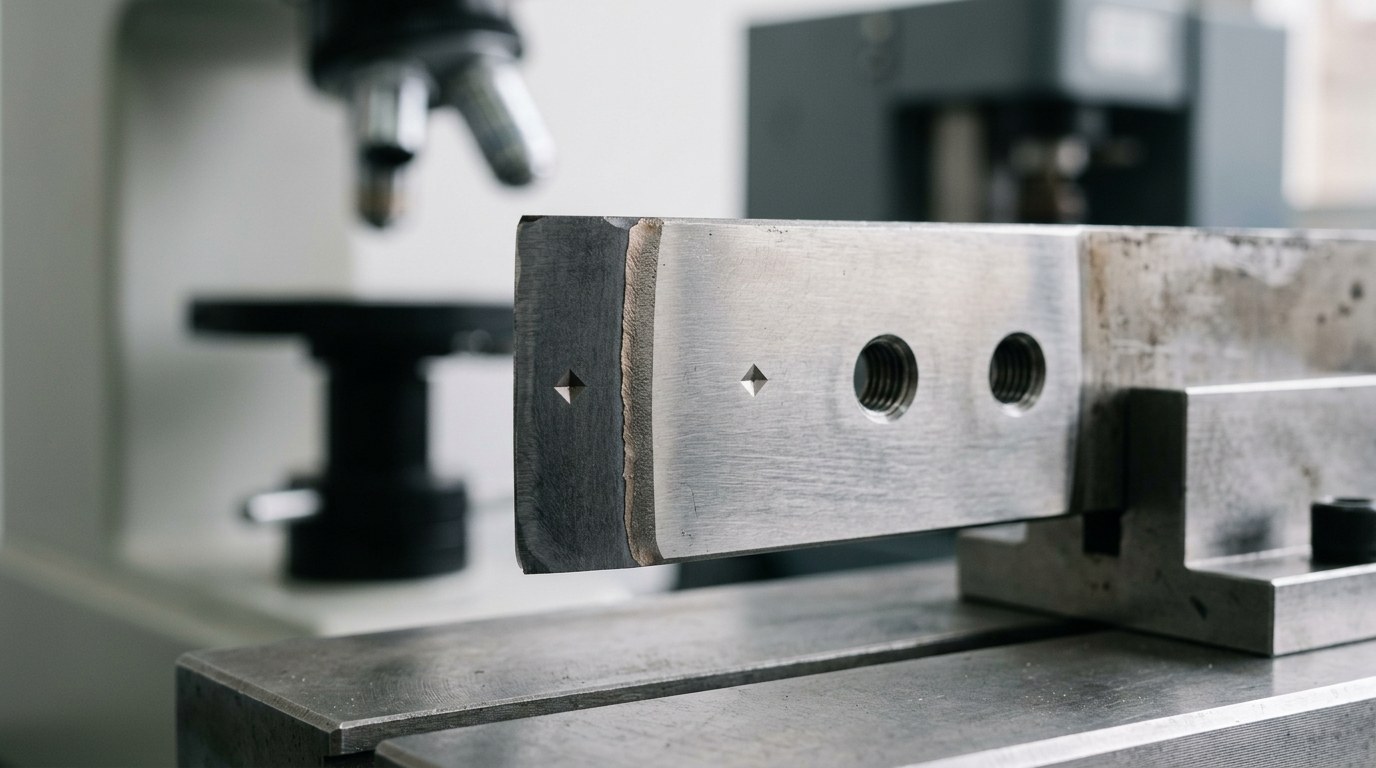
Pull a shear blade off a gantry and set it on the bench. Nearly everyone assumes it is one piece of steel hardened the same way all the way through. It usually isn’t. The cutting edge sits at 58–62 HRC while the body holding the bolts sits around 28–36 HRC — and that gap is deliberate, not a heat-treatment mistake. The shear blade edge vs body hardness split is what lets a blade stay sharp without cracking at the bolt holes, so spec and check both numbers, not just the one on the edge. A drawing that quotes a single hardness for the whole blade is missing half the story. GOOD-KNIFE issues a measured steel mill shear blade hardness report listing both zones with every order.
Key Takeaways
- Two zones, two jobs. The edge needs wear resistance (58–62 HRC); the body needs toughness (28–36 HRC) to absorb shock and hold the bolts.
- Two ways to build it: a brazed or welded tool-steel insert on a 42CrMo body, or a single steel with the mounting zone tempered back.
- Hardening the whole blade to 60 HRC cracks it at bolt holes and counterbores under impact — we see this on mobile and demolition shears most.
- 60 HRC is about 654 HB or 697 HV per ASTM E140, but conversions are approximate and should never be used as an acceptance result.
- Measure three points on delivery: behind the edge, the transition zone, and near the bolt holes. A single edge reading tells you very little.
What Is a Shear Blade Actually Made Of?
There are two common ways to get that split. One is a tool-steel insert brazed or welded onto a tough alloy body. The other is a single through-hardened blade where the mounting area is tempered back or locally annealed. Either way the blade behaves as three layers:
| Zone | Typical steel | Hardness | Typical size | Job it does |
|---|---|---|---|---|
| Cutting edge / insert | D2, M2, H13, carbide | 58–62 HRC (cold); 48–52 HRC (H13) | 8–25 mm insert | Holds the edge, resists abrasion |
| Bond / transition | Silver-copper braze or weld + tempered band | 40–50 HRC | 0.1–0.3 mm joint | Carries load between hard and soft zones |
| Body / holder | 42CrMo (4140 / SCM440 / 1.7225) | 28–36 HRC (approx. 270–340 HB) | 30–80 mm section | Absorbs shock, holds bolt holes, locates the blade |
The body is the part buyers never ask about, and it is the one that decides whether a blade survives a bad bundle. The scrap gantry blade body steel is deliberately soft: it bends a little, keeps the bolts tight, and stops a crack at the edge from running straight through the holder.
Why Can’t the Whole Blade Be Hardened to 60 HRC?
Because hardness and toughness pull in opposite directions. A bolt hole, a counterbore, or a sharp pocket corner concentrates stress; at 60 HRC there is almost no ductility left to relieve it. The table is indicative, relative to a D2 edge at 60 HRC, not a lab measurement:
| HRC band | Relative wear resistance | Shock tolerance | If used for the whole blade |
|---|---|---|---|
| 28–36 | 0.3–0.5× | High | Edge rounds off within hours on steel |
| 45–52 | 0.7–0.9× | Medium | Fine on soft scrap, poor on AR plate |
| 58–62 | 1.0× | Low | Bolt holes crack under repeated impact |
| 62–65 | 1.2–1.5× | Very low | Chips on tramp metal and mixed scrap |
This is why shear blades are not fully hardened on high-shock machines. A shredder blade insert hardness can run at 60–62 HRC because the rotor cassette takes the beating, while a demolition blade on an excavator gives up 2–4 HRC at the edge to keep the whole assembly intact. Different shock, different compromise.
How Do You Convert HRC, HB and HV on a Blade Drawing?
Chinese and US drawings usually quote HRC. European mills often quote HV or HB. The values below are the widely used HRC to HB and HV hardness conversion chart anchors from ASTM E140 for carbon and alloy steel:
| HRC | Brinell HB (approx.) | Vickers HV (approx.) | Where you see it on a blade |
|---|---|---|---|
| 30 | 286 | 302 | 42CrMo holder / body |
| 35 | 327 | 345 | Tough body, upper end |
| 40 | 371 | 392 | Transition / tempered band |
| 45 | 421 | 446 | Hot-work or tough edge |
| 50 | 481 | 513 | H13 hot shear blade |
| 55 | 560 | 595 | Lightly loaded cold work |
| 60 | 654 | 697 | D2 cold shear, target |
| 65 | 739 | 832 | M2 / high-wear service |
Treat this as a translation dictionary, not a test result. These are approximate correlations for carbon and alloy steel, not formulas — real values can drift 10–20 HV with alloy content, and above about 55 HRC the Brinell ball is too hard to give a meaningful reading. ASTM E140 itself says to convert only when a direct test cannot be made. For acceptance, measure in the scale the drawing specifies. We have had suppliers argue that a 650 HB reading “equals” 60 HRC on a rejected batch; it does not settle anything until you put a Rockwell tester on the part.
Where Should You Measure Hardness on a Delivered Blade?
One edge reading is not enough. These are the shear blade hardness acceptance check points we use on incoming inspection — confirm the exact tolerances against your own drawing:
| Check point | Expected | Typical tolerance | What a bad reading means |
|---|---|---|---|
| 3–5 mm behind the cutting line | 58–62 HRC | ±1 HRC | Soft edge — short wear life |
| Transition / bond band | 40–50 HRC | ±2 HRC | Too steep a gradient — braze or temper problem |
| Body near bolt holes | 28–36 HRC | ±2 HRC | Too hard — cracking risk at the holes |
| Three points along the length | Spread under 2 HRC | — | Uneven quench or surface decarburisation |
Ask for the readings, not just a certificate that says “passed”. The same logic applies to dies and punches: a hard working face on a tougher body is what stops a cracked sleeve after a few hundred tons, so briquetting mold core hardness should be specified as two zones too.
FAQ
Why does a shear blade have two different hardness levels?
Because the edge and the body do opposite jobs. The cutting edge needs 58–62 HRC to resist abrasion and hold a keen line; the body needs 28–36 HRC to absorb impact and keep bolt holes from cracking. Builders get this either with a brazed tool-steel insert on a 42CrMo body, or by tempering back the mounting zone of a single steel. It is a design feature, not inconsistent heat treatment.
What steel is a shear blade holder made from?
Usually 42CrMo — called 4140 in the US, SCM440 in Japan and 1.7225 / 42CrMo4 in Europe — quenched and tempered to about 28–36 HRC (roughly 270–340 HB). It is a tough, cheap alloy steel that takes shock and machines cleanly for bolt holes. It is not a cutting-edge material; 4140 on a drawing normally refers to the holder, not the knife.
What is 60 HRC in HB and HV?
Approximately 654 HB and 697 HV per the ASTM E140 carbon and alloy steel table. These are empirical correlations for steel, not exact conversions: values can shift 10–20 HV with alloy content, and above about 55 HRC Brinell readings are generally not meaningful. Never accept or reject a blade on a converted number — measure in the scale the drawing calls out.
Is a fully hardened blade better than a brazed insert blade?
Neither is automatically better. A solid through-hardened blade is simpler and cheaper and suits steady, clean cuts on plate shears. A brazed insert on a tough body costs more but survives shock and is easier to repair, which is why it dominates gantry, demolition and mixed-scrap work. Pick by impact load, not by the headline hardness number.
Where should hardness be checked on a delivered shear blade?
At three places: 3–5 mm behind the cutting line (expect 58–62 HRC, ±1), the transition or bond band (40–50 HRC), and the body near the bolt holes (28–36 HRC). Take three readings along the length too — a spread over 2 HRC points to an uneven quench or surface decarburisation. Ask for the actual readings, not a pass stamp.
A blade is a hard edge carried by a tough body, and both numbers belong on the drawing and on the inspection sheet. Spec the edge for your feed, spec the body for your shock load, convert HRC/HB/HV only to read a foreign drawing, and measure three points before you accept the batch. GOOD-KNIFE supplies measured hardness readings for the edge, transition and holder on every blade, plus the grade and heat-treatment route in writing — see the full range at GOOD-KNIFE or send us your drawing for a like-for-like quote.